My remote paralegal has too little work. What should I delegate?
By Adriana Vela · Sep 30, 2026 · 6 min read

Your remote paralegal has finished their assignments, but you still have documents to review and clients to update. Before you decide you're paying for too many hours, check whether the work is reaching them consistently. When each assignment depends on someone remembering to send it, a capable paralegal runs out of work on quiet days and gets bypassed on busy ones, because doing it yourself feels faster than explaining it.
A family law firm in Sonoma County went through this. During a stretch of staff turnover, its paralegal spent her first months on phones and admin, and the firm said so plainly: "we were definitely under utilizing her." Once it moved her to paralegal work, "she's been doing great."

1. Find out why the work is running out
Running out of work has more than one cause, and each has a different fix.
| What you notice | Likely cause | What to do |
|---|---|---|
| They finish early and wait for the next email | Work only reaches them when someone remembers to send it | Give each recurring responsibility a starting point (step 3) |
| Drafts sit with you for days | The work is waiting on your review | Set a regular review time, and let routine administrative items go ahead once they've proven reliable |
| They stop partway through a task | Missing documents or system access | Fix access first, and have them flag missing inputs every morning |
| The work comes back wrong or slowly | The work doesn't match their experience | Start with routine responsibilities, and add the rest with direction (step 2) |
| There's little to do on any file | Case volume really is low | Use the slow-week list, or hire for fewer hours (step 8) |
2. Choose responsibilities by practice
Start with routine work that repeats, begins from inputs you can list, and ends in something you can check. Add more complex work as the paralegal shows they can handle it, always with your direction. Recurring work includes anything a case event sets off, such as an RFE, as well as weekly work.
| Practice | Start with | Add with experience and your direction | Stays with the attorney |
|---|---|---|---|
| Personal injury | Records and bills requests and follow-up; treatment updates from clients; tracking outstanding requests and liens | Medical chronologies; discovery drafts; demand package preparation | Legal positions and demand strategy |
| Immigration | Collecting and organizing evidence; tracking receipt notices, biometrics and filing dates; approved client reminders in English and Spanish | Preparing forms such as the I-130 and I-485; drafting RFE and NOID responses | The filing approach and the response strategy |
| Employment | Organizing personnel files and pay records; preparing document productions | Charge drafts; pleadings and declarations from your templates; wage-and-hour worksheets | The legal assumptions behind any wage-and-hour calculation, and legal positions |
The attorney stays responsible for the paralegal's work, and keeps the legal judgment and the signature.
3. Give every responsibility a starting point
A written guide explains how to do the work. It doesn't tell your paralegal which file needs attention tomorrow morning. For that, each recurring responsibility needs a trigger. When a matter reaches the right stage in your case management system, the task is assigned to the paralegal with a due date and a reviewer, and the paralegal checks that queue every morning and flags anything missing or blocked. Assigning by hand works as well as an automation, as long as each task has an owner, a priority and a place where everyone can see it.
| Responsibility | What starts it | What the paralegal works from |
|---|---|---|
| Medical records requests | The client's authorization and the provider list are in the file | Assigned records-request tasks |
| Immigration evidence collection | The attorney approves the matter's document checklist | The list of outstanding documents |
| Client updates | A scheduled update is due, or the attorney approves news to share | Assigned update tasks |
4. Write each responsibility on one page
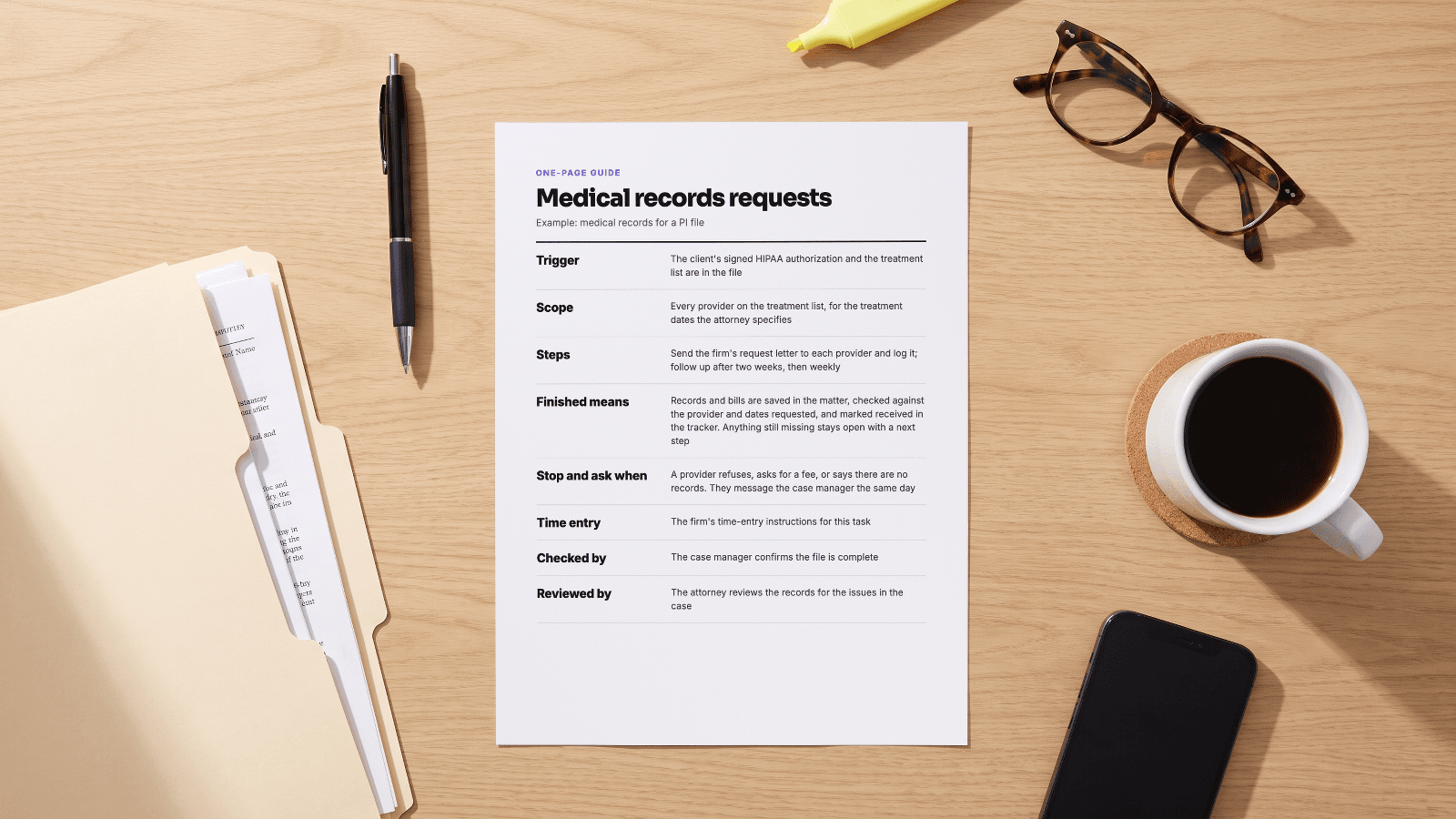
The one-page guide answers the questions your paralegal would otherwise have to send you. The example below covers medical records for a PI file, from the first request to the last record. The follow-up schedule is an example, so use your firm's.
| Part | What to write | Example: medical records for a PI file |
|---|---|---|
| Trigger | What must be in place before it starts | The client's signed HIPAA authorization and the treatment list are in the file |
| Scope | Which matters, providers or dates it covers | Every provider on the treatment list, for the treatment dates the attorney specifies |
| Steps | The work, including follow-up | Send the firm's request letter to each provider and log it; follow up after two weeks, then weekly |
| Finished means | What done looks like | Records and bills are saved in the matter, checked against the provider and dates requested, and marked received in the tracker. Anything still missing stays open with a next step |
| Stop and ask when | Where their decision ends, and who they tell | A provider refuses, asks for a fee, or says there are no records. They message the case manager the same day |
| Time entry | How to record the time | The firm's time-entry instructions for this task |
| Checked by | The operational check | The case manager confirms the file is complete |
| Reviewed by | The legal review | The attorney reviews the records for the issues in the case |
Once you've written two or three, your paralegal can draft the rest for you to correct and approve.
Give clear time-entry instructions too, covering substantive legal work, administrative work and training. At the Sonoma County firm, the paralegal's billable hours were low, and the firm traced it to its own guidance. Her attorneys now tell her, as they assign work, "this is something that you can bill for so make sure you get your time in." Whether an entry can be charged to a client depends on the work itself, your engagement terms and the rules that apply to you. The ABA's guidance for lawyers on paralegals separates substantive legal work, which may be billed, from clerical work, and every fee has to be reasonable (Model Rule 1.5). The attorney reviews client charges. In a contingency practice, billable hours say little about workload, so look at completed work, open requests, rework and the time you spend reviewing.
5. Settle the remote basics before the first assignment
Decide a few things before the first task goes out. Give your paralegal their own login for each system you approve, so you can always see who did what. Agree where documents may be stored and how they're sent, run a conflict check, set the hours they should be reachable, and name who they go to when you're in court. The duty to protect client information applies whatever the setup (Model Rule 1.6). How closely you supervise depends on the person's experience, the work and the jurisdiction where they work (Model Rule 5.3, comment 3). The ABA's opinion on outsourced work says clients should be told when people outside the firm work on their matters, and should consent before those people receive confidential information (ABA Formal Opinion 08-451). Your state's rules govern.
6. Add responsibilities as they become reliable
A typical first month adds one responsibility at a time. Move to the next step when the last one is coming back right, not because a week has passed. An experienced paralegal on familiar work may move faster, and an unfamiliar filing may need close review well past the first month.
| A typical first month | What to hand over | How you review it |
|---|---|---|
| Week 1 | Access, and one routine responsibility from the "start with" column, done end to end | Review the first work closely and explain every correction |
| Week 2 | A second routine responsibility, and client updates from a script you approve | Ease checking only on tasks they've shown they do reliably |
| Week 3 | First drafts from your templates, such as a chronology or a form | Review every draft before it's used, filed or sent |
| Week 4 on | They work from the queue without waiting to be asked | A weekly workload review, alongside the approval each task needs |
A weekly workload meeting doesn't replace the review a particular piece of work needs.
Engelman Law, a personal injury practice, shows how a role can grow as the attorney gains confidence in the work. By her second month, the paralegal, Rosella, was running discovery with co-counsel and taking client calls. At her one-year review, Britany Engelman said: "Rosella is very capable of taking things and just having a list of assignments and working on them and getting them done on her own."
7. Know what's yours and what Interstaff handles
With a managed placement from Interstaff, the work splits like this:
| Your firm | Interstaff |
|---|---|
| Decides what to hand over, and in what order | Runs payroll, hours and time off |
| Writes or approves the one-page guides | Sends the holiday schedule in advance |
| Reviews the work and keeps the legal judgment | Checks in often during the first two months |
| Gives time-entry instructions and reviews client charges | Holds reviews with your firm and with the paralegal, and sends the action points in writing |
You don't have to work out the role alone. Interstaff's talent manager can sit down with you to list the role's tasks, write day-to-day and monthly guides for them, and then walk your paralegal through the guides.

8. If there still isn't enough work
Every practice has slow weeks. A standing list keeps them useful: drafting the next one-page guides, turning your best past filings into templates, chasing overdue records and documents, and cleaning up files so they can be found later. If the list still leaves hours empty, the answer is fewer hours: size the role to the work you actually have.
Your next step this week: choose one responsibility from the "start with" column, write its one-page guide, and agree on its trigger and its review with your paralegal.
If your list shows you need a different skill set or a different number of hours, see candidates before you interview. Profiles show each candidate's weekly availability, and the rate where one is listed, and you can shortlist without logging in.
FAQ
Questions we get every time.
Start with a routine responsibility that has a clear starting point and a result you can check, such as medical records requests in a PI practice or evidence collection in an immigration practice. Add the next one when the first is coming back right.
Adriana Vela
Host, Interstaff
Adriana Vela hosts Interstaff's videos and writes about how small law firms work with remote staff.