
The assistant who checks every citation
By Interstaff Team · Jun 24, 2026 · 2 min read
Most delegation breaks on the detail work. You can hand off the calendar. Handing off a brief, where one wrong page reference can sink an argument, is the part owners keep for themselves. Hathaway Parker stopped having to.
The situation
Hathaway Parker is a litigation firm in Los Angeles. The work is document-heavy: long briefs, dense citations, every page reference checked before anything goes out. Underneath that sits the calendar, the contact records, the court filings, the steady administrative load that has to run on time every day or deadlines slip.
The firm did not need two people. It needed one who could hold both the detail and the cadence at once.
What changed
Interstaff placed Maria, a bilingual LATAM legal virtual assistant. Same model as every placement: a workflow plan first, then a trained legal operator who already understood document review and intake, then a managed service layer running performance and communication behind the scenes.
By the one-year mark, Maria was running the firm's calendar and reviewing its briefs. Making grammatical edits. Confirming each citation pointed to the correct page. Flagging what needed a second look. Around that she handled the steady stream of smaller work: adding contacts to the management system, drafting short documents, downloading court filings as they came in.
The firm and Maria work on Microsoft Teams in constant back-and-forth, not by handing off and hoping. That is the difference between a placement that lasts and one you end up redoing.
The result
At her annual review, the firm singled out brief review as her standout contribution. The grammar. The citation accuracy. The catches before filing. They described her as collaborative, responsive, and proactive: prompt to requests, quick to ask for clarification, and notably good at taking direct feedback.
One of the things she does best is to review documents... she's fantastic at reviewing those documents, making grammatical edits, and then checking to see that the citations go to the correct page. That's one of the most valuable qualities she brings to us.
A year in, she is still the one the firm hands its briefs to. That is the test. Not whether a placement survives the first month, but whether the highest-stakes work still flows to them after twelve.
Why it held
Three things made the detail work delegable:
- A trained operator, not a generalist. Maria understood document review before day one, so the firm was not teaching litigation basics on top of its own deadlines.
- A real working channel. Constant Teams back-and-forth meant questions got answered in minutes, not lost in a daily handoff.
- A manager in the loop. Performance and communication ran behind the scenes, so the firm got the output without becoming the supervisor.
If the work you most want off your plate is also the work you trust least to anyone else, that is usually a setup problem, not a talent one. The fix starts with mapping it.
Get my 15-minute planInterstaff Team
Interstaff
The Interstaff team on staffing, AI, operations, and growth for lean service businesses.
Related reading
Hiring & Staffing
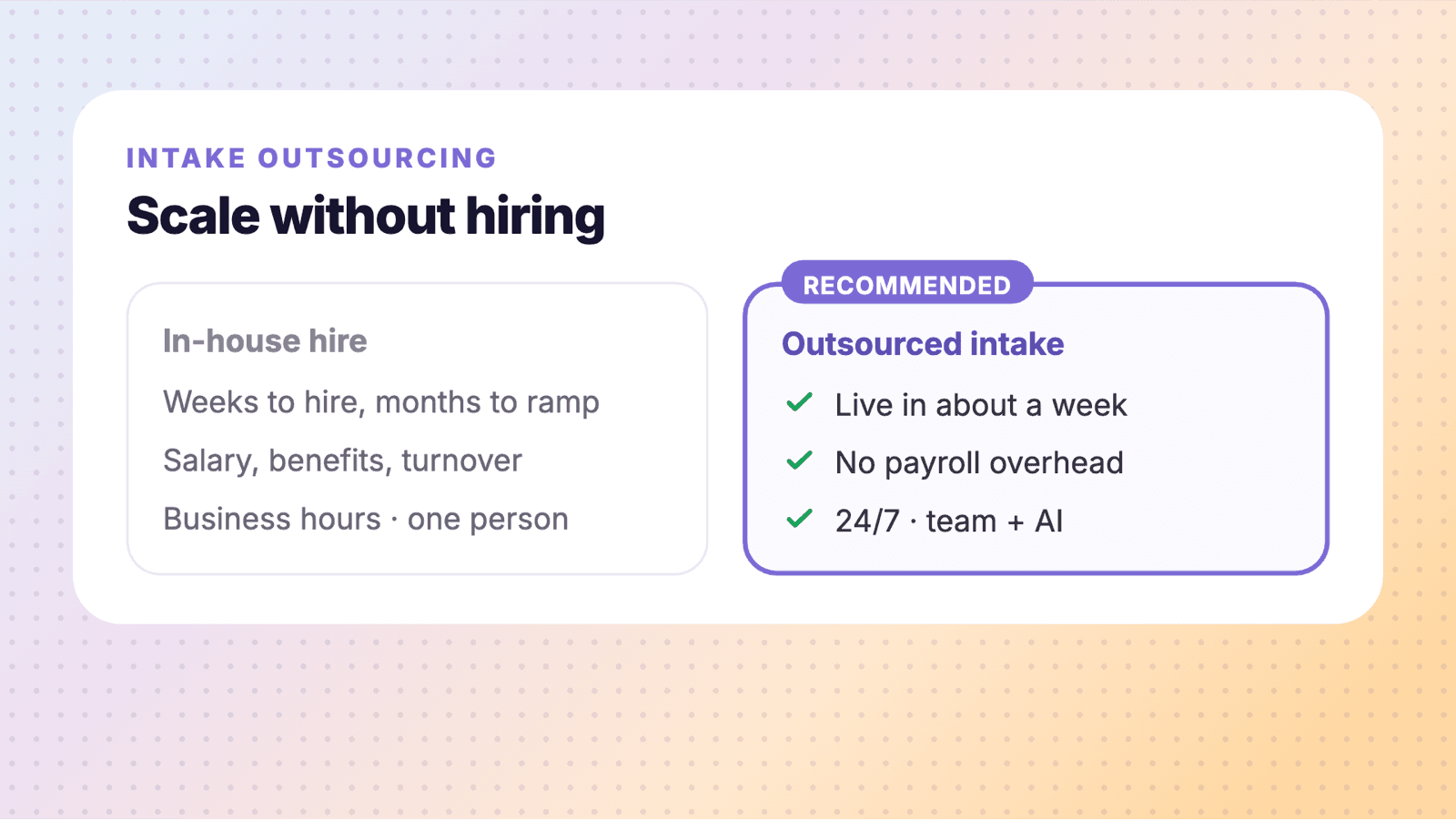
Legal Intake Outsourcing: How Small Firms Scale Without Hiring
Legal intake outsourcing lets small firms catch and convert more leads without hiring. Here is how it works, what it includes, and how it compares to an in-house hire.
Manuel M. · Jun 24, 2026 · 2 min read
Hiring & Staffing
Hiring a VA is the easy part
Posting a job and picking on price is easy. Doing it so the hire still works three months later is the part that breaks. The problem was never the resume. It was the process.
Cris Thomas · Jun 23, 2026 · 2 min read
Hiring & Staffing
From one placement to two, plus a referral
Engelman Law APC started with one Interstaff legal assistant. In the same week a year later, the firm added a second placement and sent a referral. Here is what changed.
Interstaff Team · Jun 22, 2026 · 2 min read